Insurance and Safety for Commercial Waste Aldgate
Why Choose an Insured Rubbish Company in Aldgate
 Commercial Waste Aldgate businesses require an organised, compliant approach to waste management. Choosing an insured rubbish company is not only a sign of professional reliability but a legal and practical safeguard. A fully insured waste removal company will carry the appropriate indemnities, including public liability and employer’s liability insurance, so your business is protected if accidents, damages or third-party claims occur during collections or on-site works.
Beyond policy certificates, a reputable insured rubbish collection provider demonstrates transparent operational controls, documented risk assessments and a visible safety culture. This protects property, staff and visitors and reassures landlords, insurers and compliance officers that waste handling is contracted to a company with formal cover and competent systems.
Public Liability Insurance: What It Covers
Public liability is the cornerstone of any insured commercial waste company. It covers claims from members of the public or clients for injury, property damage or loss that occur because of the contractor’s activities. For Commercial Waste Aldgate operations, this commonly includes damage caused by vehicle movements, dropped loads, accidental spillage, or incidents during bin placements. Having adequate cover limits is essential; industry-standard levels are often required by commercial clients and by local authorities.An insured waste company should provide a current certificate of insurance on request and clearly state the cover limits and policy periods. Businesses should verify that the insurer and the insured business names match contracts and that public liability coverage extends to work carried out at customer sites in Aldgate and surrounding boroughs. For sensitive sites and high-risk materials, additional specialist cover may be recommended.
Insurance alone is insufficient without robust risk control. That is why an insured rubbish company will have documented staff training programmes, regular competency checks and an induction process for new operatives. Staff who understand waste classifications, segregation rules and manual handling techniques reduce the risk of incidents and insurance claims.
 Staff training typically includes on-the-job supervision, toolbox talks, accredited courses where required and written records of attendance. In the context of a commercial waste contractor, training covers safe vehicle operation, correct bin-lift and emptying procedures, spill response, and safe handling of potentially hazardous or sharp items. Ongoing training and refresher sessions are critical for maintaining standards and demonstrating due diligence to insurers.
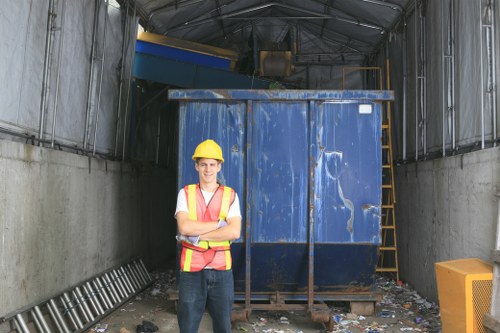
Personal Protective Equipment (PPE) forms another visible sign of a competent, insured waste removal company. Proper PPE reduces injury severity and signals to clients and insurers that the contractor takes frontline safety seriously. Common PPE items used in commercial waste collection include:
- High-visibility clothing for operatives working near traffic
- Cut-resistant gloves and steel-toe boots for manual handling
- Hard hats where overhead hazards exist
- Eye protection and masks when handling dusty or contaminated wastes
An insured commercial waste company will maintain PPE records, replacement schedules and enforce usage through supervisory checks. This practical approach reduces claim likelihood and supports worker welfare.
Risk assessment is the structured process that links insurance, training and PPE into an enforceable safety system. A robust risk assessment process for Commercial Waste Aldgate typically follows the steps below and is documented for audit and insurance purposes:
- Identify hazards — including vehicle movements, manual handling, sharps and hazardous materials.
- Evaluate risks — decide who might be harmed and how, and rate likelihood and severity.
- Control measures — implement engineering, administrative and PPE controls.
- Record actions — maintain written assessments and care plans.
- Review regularly — update assessments after incidents or operational changes.
These assessments should be tailored to each site and contract. For example, a busy retail loading bay in Aldgate will require different controls than an industrial yard. Insured waste contractors provide customised risk assessments that demonstrate competence to clients and insurers alike.
Documentation matters. An insured rubbish company maintains a suite of records — insurance certificates, risk assessments, training logs, vehicle maintenance histories and incident reports — that together show a traceable commitment to safety. During contract tendering or routine audits, this documentation validates that the operator is working within acceptable risk thresholds and covered for potential claims.
 Incident reporting and post-incident reviews are part of the safety feedback loop. Quick reporting, transparent investigation and corrective actions help prevent recurrence and may reduce the insurer’s exposure. A proactive approach can also lower premiums over time by demonstrating a consistent reduction in claims frequency and severity.
 In summary, choosing an insured rubbish company or an insured waste removal company for Commercial Waste Aldgate means selecting a partner who combines adequate public liability insurance with strong operational controls: trained staff, enforced PPE use and a rigorous risk assessment process. These elements together protect your business, the public and the waste contractor, creating a compliant, resilient service for commercial waste needs in Aldgate and beyond.